Human interactive patterns in temporal networks
IEEE Transactions on Systems, Man, and Cybernetics: Systems 45(2): 214 to 222, February 2015 published
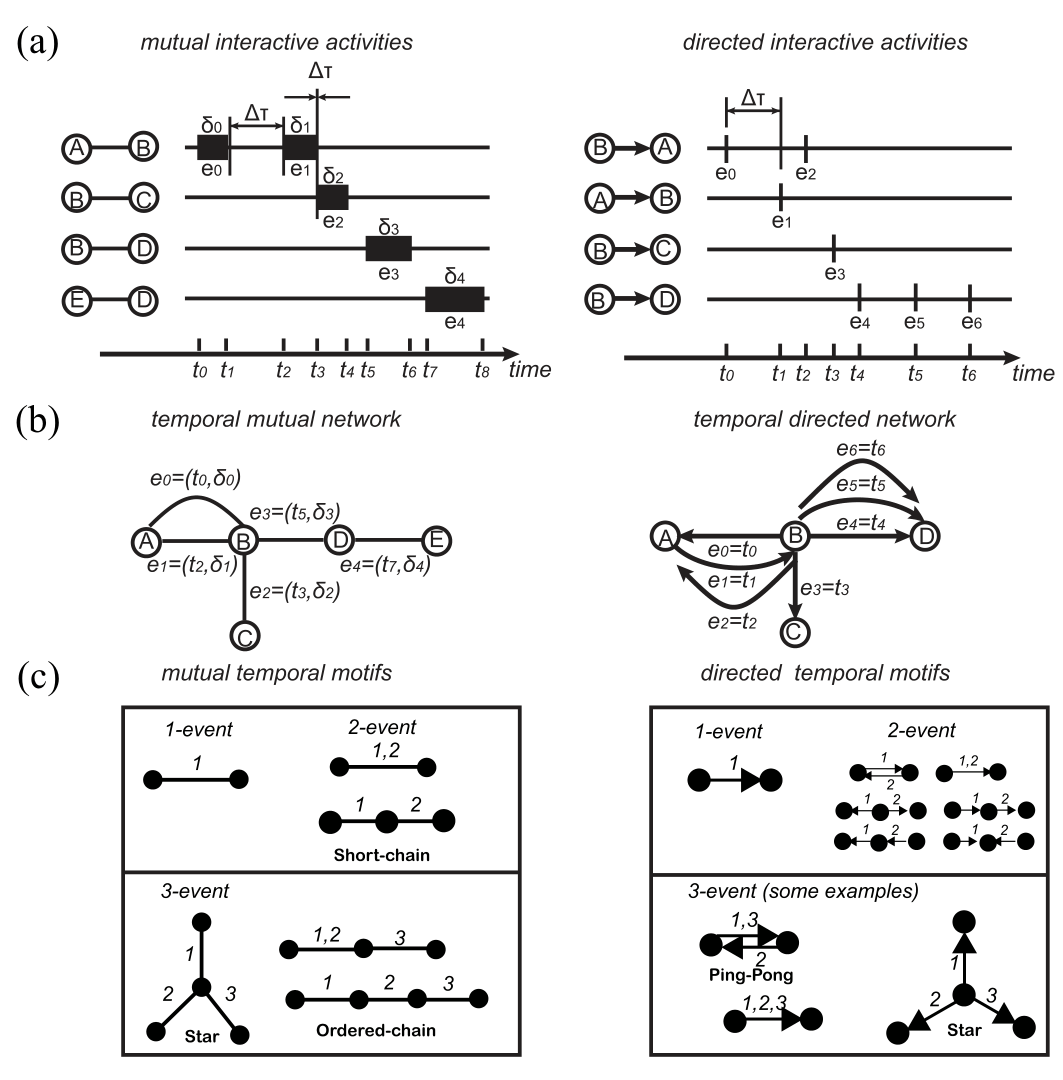
Phone logs, Wi-Fi logs and badge sensors record not just who interacts with whom but in what order. An ordinary network diagram throws that order away. This paper keeps it by counting temporal motifs: small groups of interactions that follow closely one after another and share people. Across six datasets, three shapes dominate: one person contacting three others in turn (a Leader), contact passing down a line of people (a Queue), and two people messaging back and forth (Feedback). The gaps between these interactions are bursty, and each pattern has its own time scale, from three minutes for text replies to seven days on an online forum.
Abstract
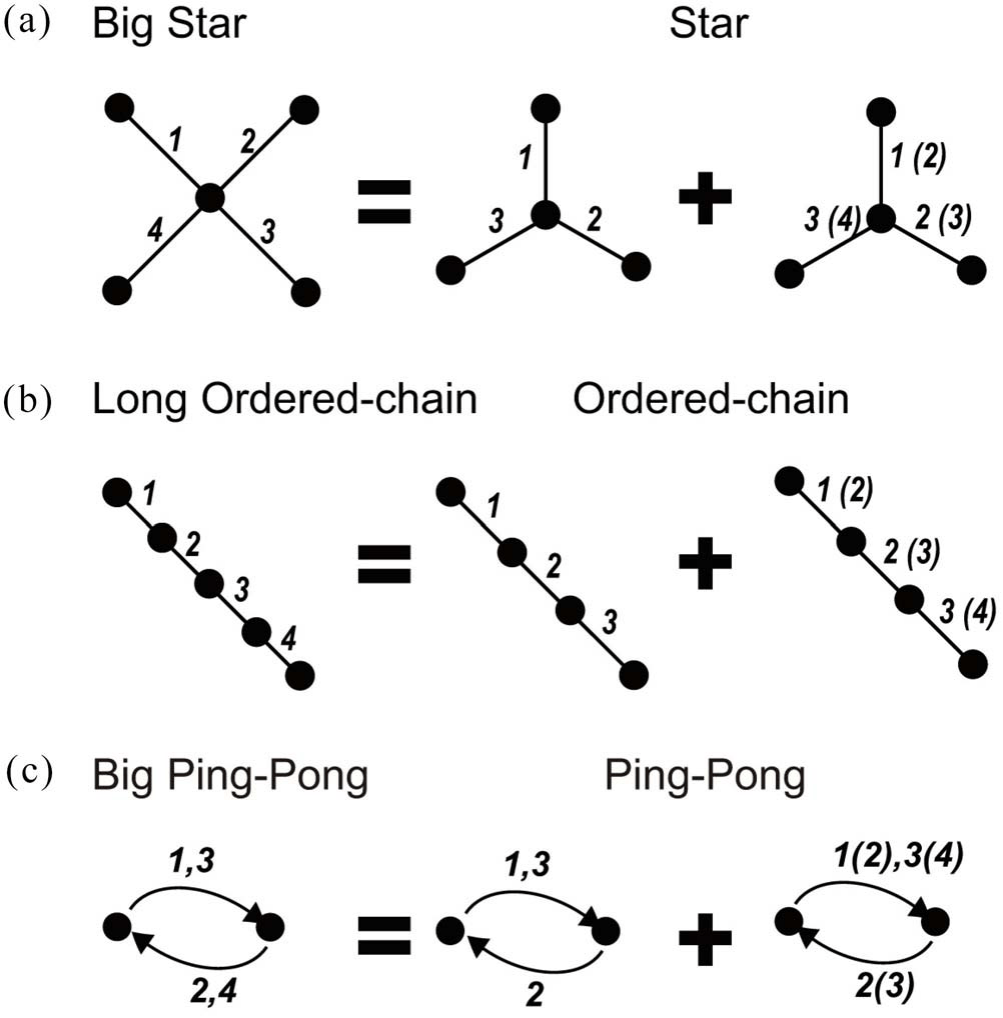
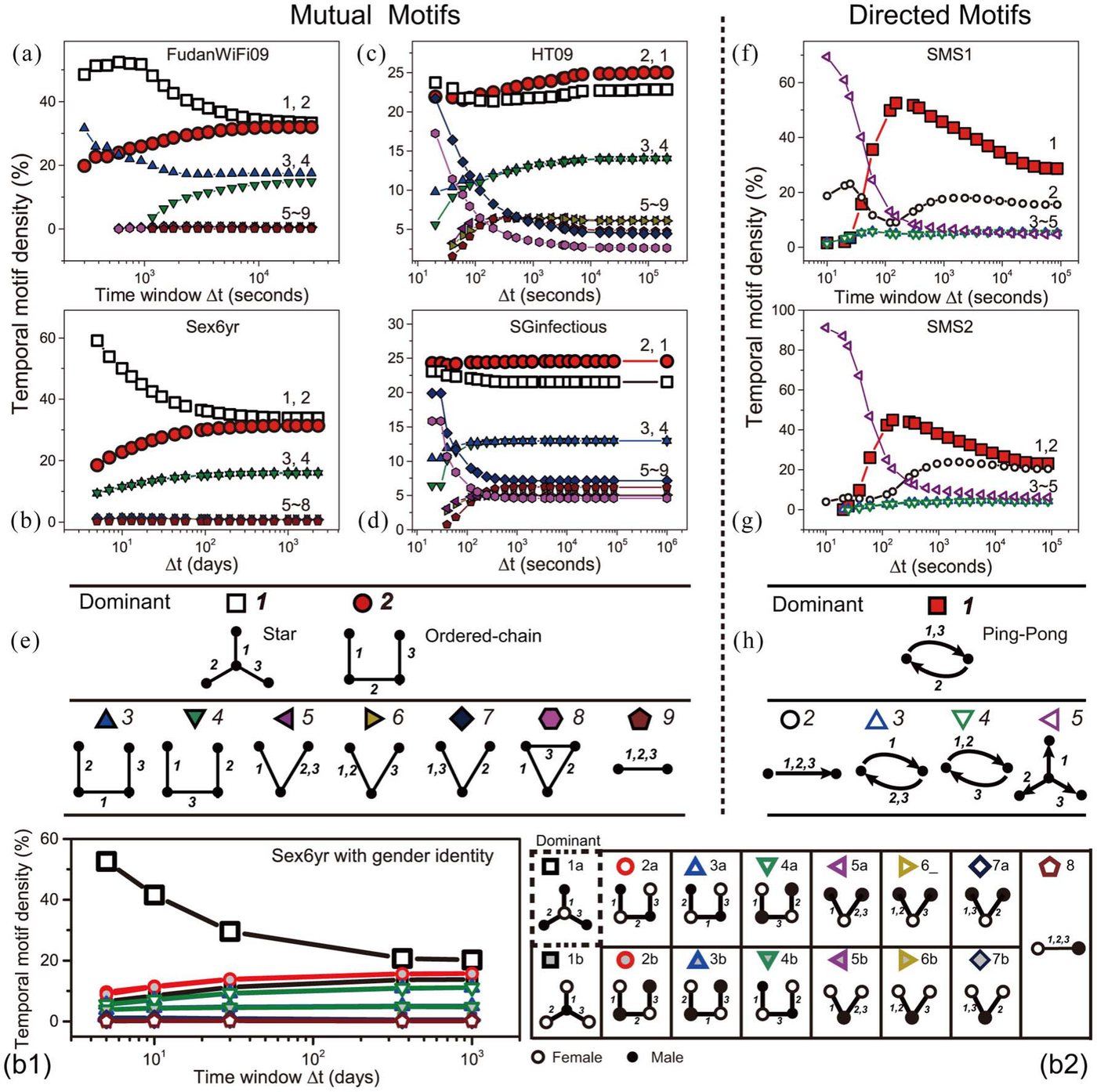
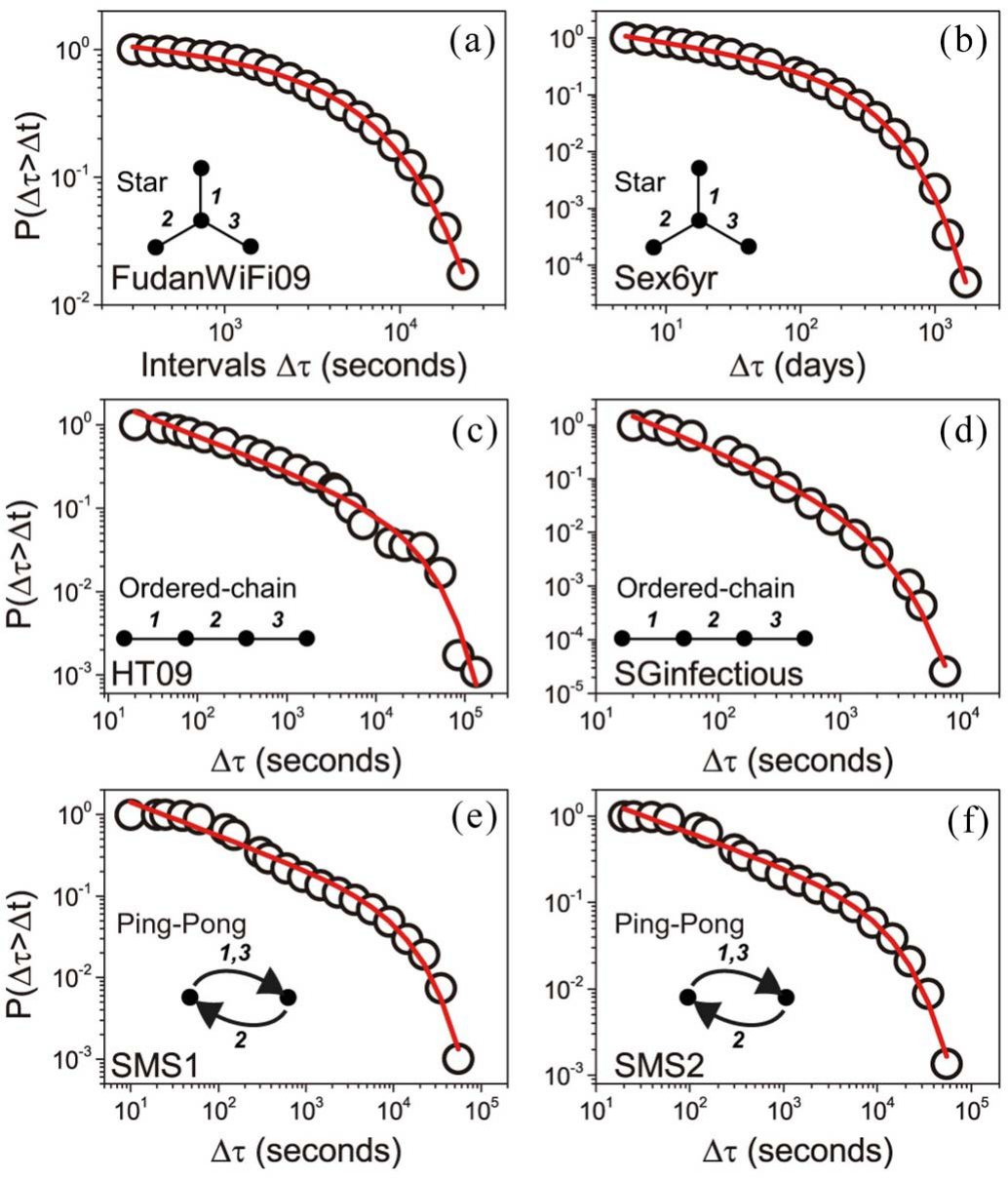
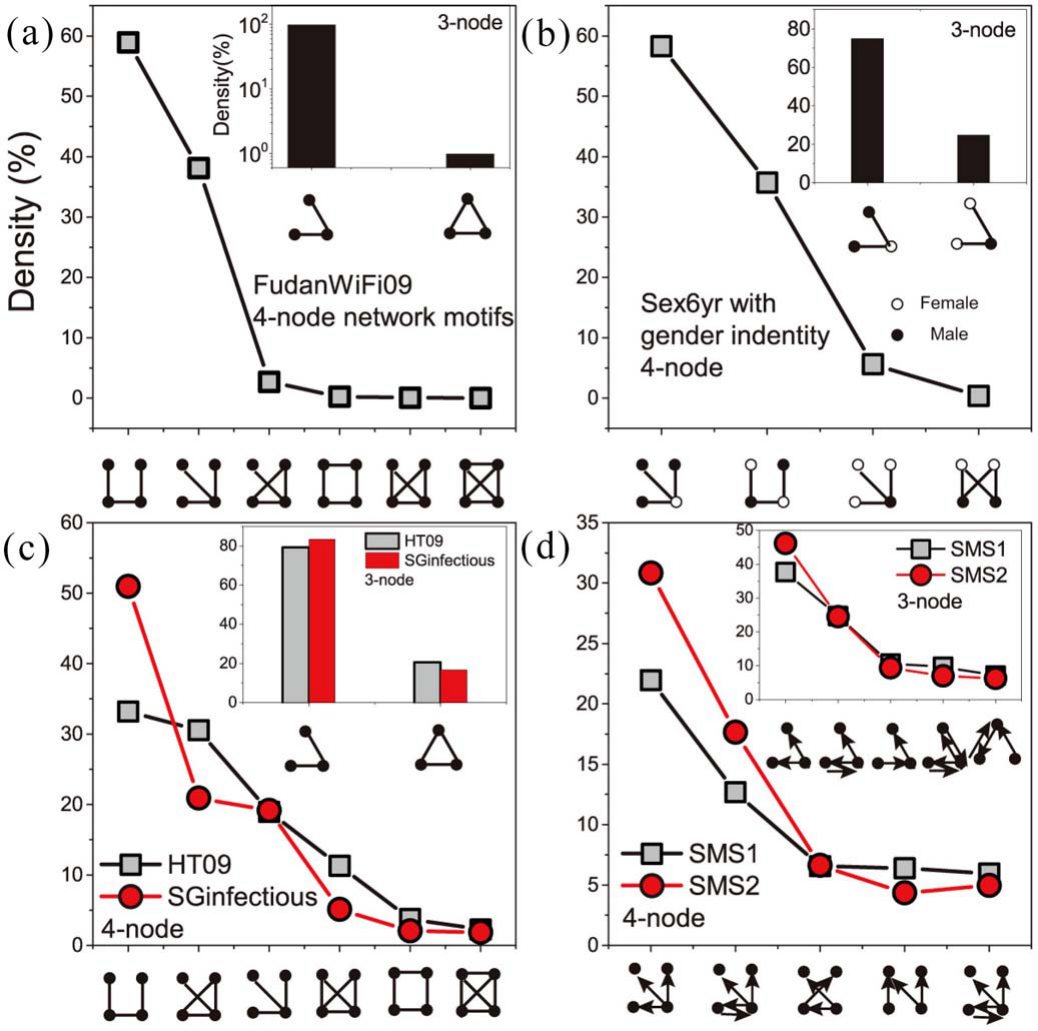
Modern information and communication technologies provide digital traces of human interactive activities, which offer novel avenues to map and analyze temporal features of human interaction networks. This paper explores mesoscopic patterns of human interactive activities from six real-world interaction networks with temporal-topological isomorphic subgraphs, i.e., temporal motifs. We discover two dominant mutual motifs, “Star,” “Ordered-chain,” and one dominant directed motif, “Ping-Pong,” which characterize the interactive patterns of “Leader,” “Queue,” and “Feedback,” respectively. Moreover, temporal dynamics shows that bursts are universal in human mesoscopic patterns, and the evolution of three dominant temporal motifs indicates the existence of characteristic time. Finally, we analyze temporal robustness and generalization to verify that 3-event temporal motifs are a simple yet powerful tool to capture the mesoscopic patterns of human interactive activities.
What a temporal motif is
An event is one timed interaction between two people. Two events are adjacent if they share a person and the second starts within a time window Δt of the first ending. A temporal motif is a group of events linked this way, with nobody interacting with anyone else in between. Motifs are told apart by their shape and by the order of their events, which is why the diagrams number the edges 1, 2, 3.
The six datasets
| Dataset | What an interaction is | People | Events | Days |
|---|---|---|---|---|
| FudanWiFi09 | two people on the same campus Wi-Fi access point | 17,881 | 209,137 | 84 |
| Sex6yr | contacts between sellers and buyers on a Brazilian online forum | 16,102 | 42,851 | 2,232 |
| HT09 | face-to-face conversations at a conference, from RFID badges | 113 | 8,641 | 3 |
| SGinfectious | face-to-face conversations at a museum exhibition, from RFID badges | 10,924 | 138,567 | 81 |
| SMS1 | text messages, one mobile operator | 9,259 | 22,771 | 1 |
| SMS2 | text messages, a second operator | 12,001 | 25,543 | 1 |
What we found
- Three shapes dominate. Star and Ordered-chain lead in the four proximity and face-to-face datasets; Ping-Pong leads in both text-message datasets.
- Without timing, the patterns disappear. In the same data with time order removed, the static chain outnumbers the static star, so the Leader pattern is hidden; in text messages the back-and-forth of Ping-Pong vanishes entirely.
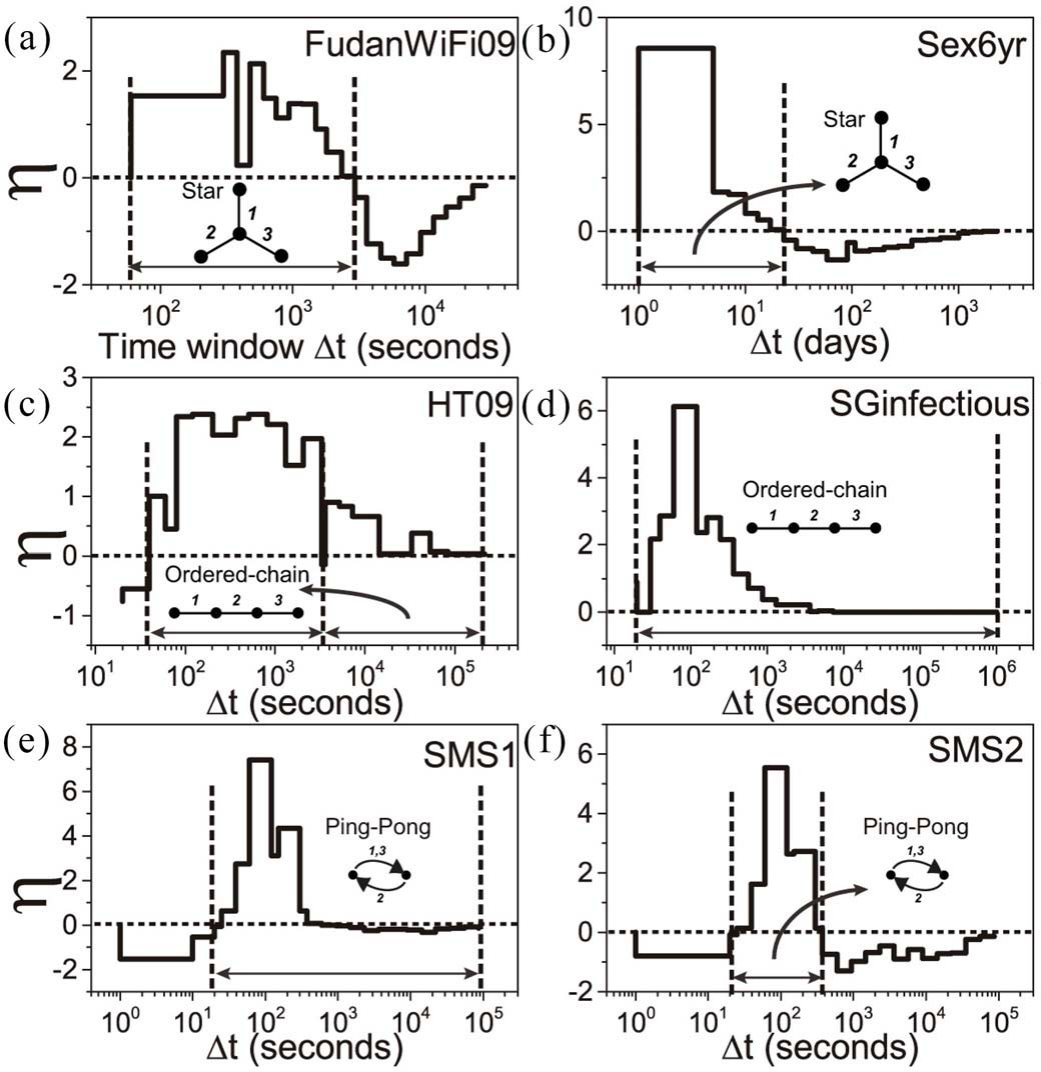
- Bursts everywhere. Gaps between events inside each dominant motif are bursty in all six datasets, fitting a power law with an exponential cutoff far better than an exponential.
- Each pattern has a characteristic time. Leader: 20 minutes on campus Wi-Fi and 7 days on the forum. Queue: 26 and 21 minutes at the two badge-sensor venues. Feedback: 3 minutes in both text-message datasets.
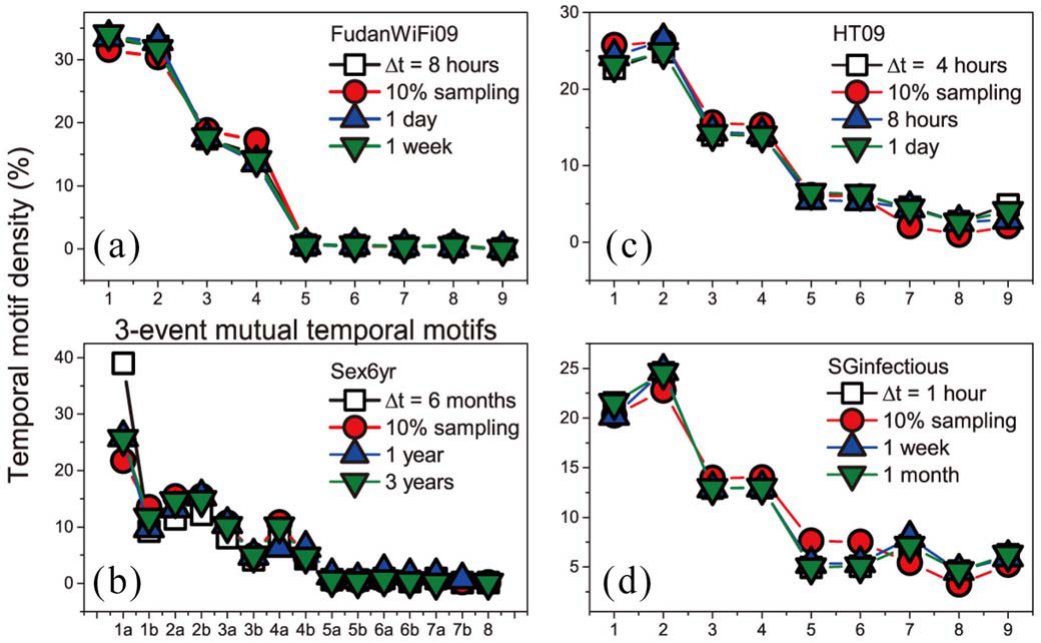
- The results are robust. Motif shares barely change when 90% of events are removed at random or only part of the collection period is used.
Figures
Cite
@article{zhang2015human,
  title   = {Human Interactive Patterns in Temporal Networks},
  author  = {Zhang, Yi-Qing and Li, Xiang and Xu, Jian and Vasilakos, Athanasios V.},
  journal = {IEEE Transactions on Systems, Man, and Cybernetics: Systems},
  volume  = {45},
  number  = {2},
  pages   = {214--222},
  year    = {2015},
  doi     = {10.1109/TSMC.2014.2360505}
}