Mining features associated with effective tweets
IEEE/ACM International Conference on Advances in Social Networks Analysis and Mining (ASONAM 2017), Sydney, pp. 525 to 532 published, free to read
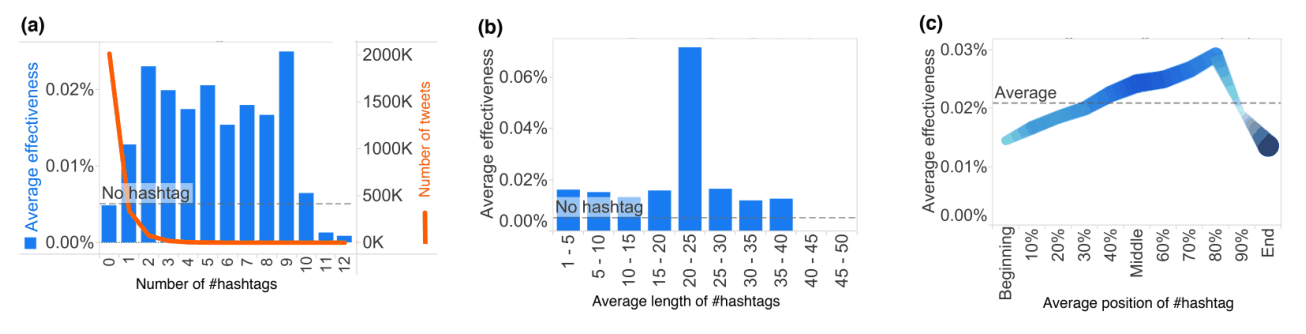
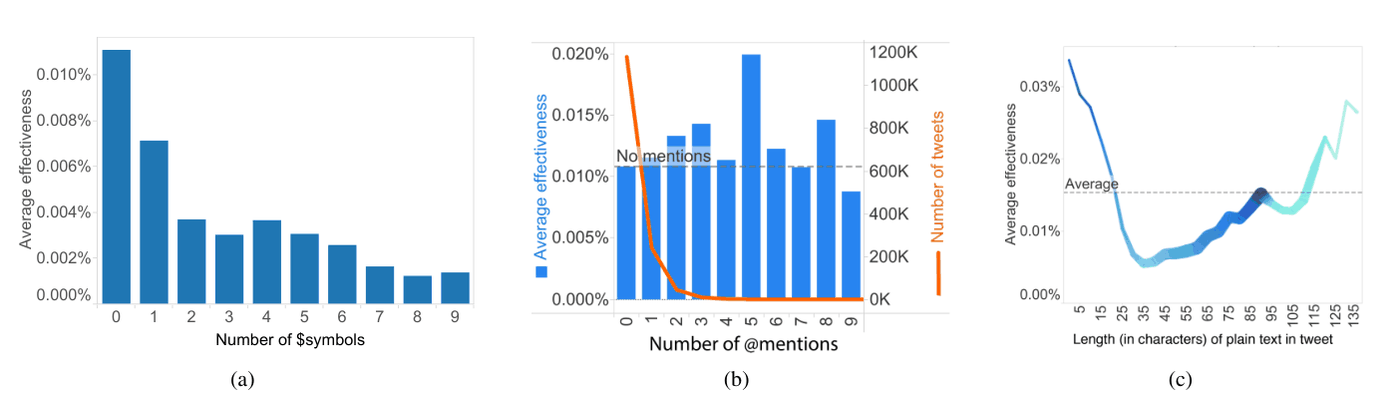
A tweet from an account with millions of followers is not necessarily an effective one. We scored each tweet by its retweets, favorites and replies divided by the poster's follower count, and measured this for 2.5 million original tweets from 258 media, company, investor and CEO accounts over 18 months. Many features matter, but rarely in a straight line: a few hashtags beat none or many, very short and very long tweets beat mid-length ones, and pictures, exclamation marks and weekend posting go with more engagement. These are associations, not causes, but they argue against the linear models usually used to predict engagement.
Abstract
What tweet features are associated with higher effectiveness in tweets? Through the mining of 122 million engagements of 2.5 million original tweets, we present a systematic review of tweet time, entities, composition, and user account features. We show that the relationship between various features and tweeting effectiveness is non-linear; for example, tweets that use a few hashtags have higher effectiveness than using no or too many hashtags. This research closely relates to various industrial applications that are based on tweet features, including the analysis of advertising campaigns, the prediction of user engagement, the extraction of signals for automated trading, etc.
What we found
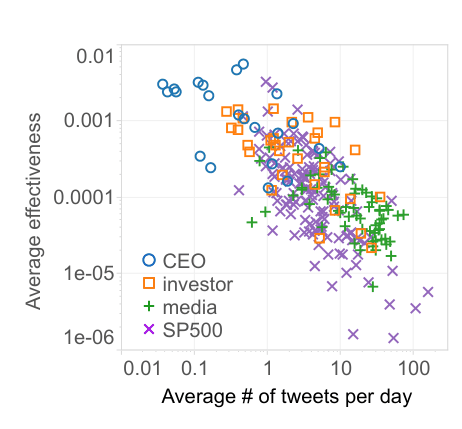
- Followers are not effectiveness. @Disney and @WholeFoods have similar follower counts, yet Whole Foods' tweets are 471 times less effective on average. Accounts that post ten times as often see roughly ten times lower effectiveness per tweet.
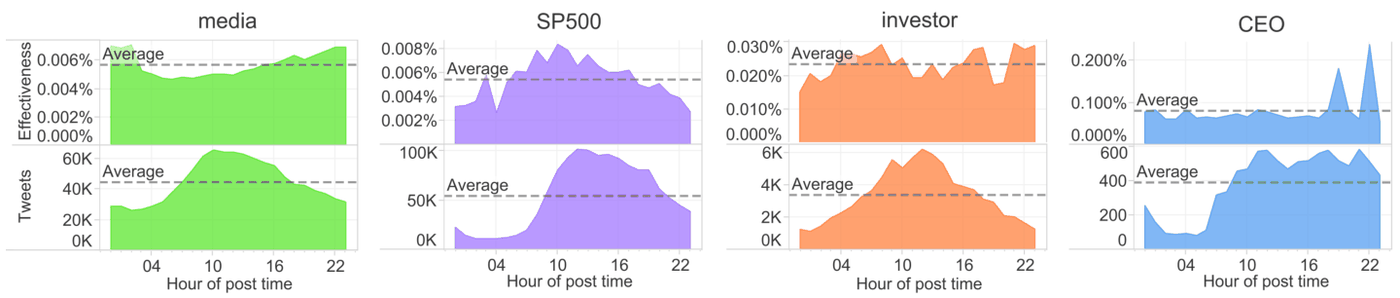
- Timing. Sunday tweets are 30% more effective than Thursday tweets, yet accounts post half as much at weekends. Media tweets engage best at night, while media accounts post most during working hours.
- Pictures and punctuation. A picture goes with 4.5 times the effectiveness, but only 17% of tweets have one. One exclamation mark goes with 2.3 times; a reply is 11 times less effective than a standalone tweet.
- Non-linear almost everywhere. Three links beat none and beat four; tweets under 20 or over 115 characters beat the mid-length majority; mentioning more than eight accounts hurts.
- Account details barely matter. Follower count, verification, profile customization and location settings show no significant association; newer accounts do better.
Contributions
- A follower-normalized measure that counts retweets, favorites and replies. Favorites and replies are 47% of all engagement, so retweet-only measures miss about half.
- A systematic review across posting time, entities, composition and account features, broken down by type of account.
- Evidence that most feature effects are non-linear, and the first look at GIFs, videos and the posting app as factors.
- A continuous 18-month collection from Twitter's streaming API, with tweet IDs released for others to use.
Where it started
The project began in spring 2013 as PowerTweet, a tool Wenzhao Sun and I built to analyze more than 200 Twitter accounts of Schurz Communications' media properties. It won first prize in the Schurz Innovation Award on Data Mining at Notre Dame that May. From November 2013, the same Twitter collection fed both this paper and our study of news diffusion and trading.
Figures
Cite
@inproceedings{xu2017mining,
  title     = {Mining Features Associated with Effective Tweets},
  author    = {Xu, Jian and Chawla, Nitesh V.},
  booktitle = {Proceedings of the 2017 IEEE/ACM International Conference on
               Advances in Social Networks Analysis and Mining (ASONAM '17)},
  pages     = {525--532},
  year      = {2017},
  publisher = {ACM},
  doi       = {10.1145/3110025.3110126}
}