Information diffusion on social media: does it affect trading, return, and liquidity?
SSRN working paper 2935138, first posted 2017, revised 2022. Earlier version: Catching Fire: the Diffusion of Retail Attention on Twitter (2015) working paper
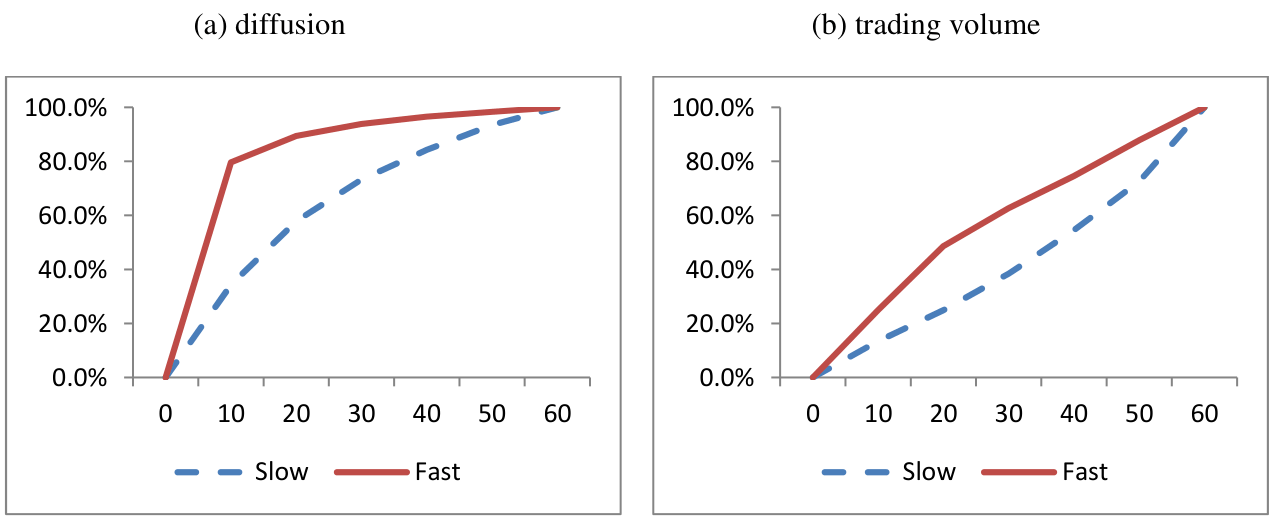
We began this project in 2013, and it was one of the first studies to track how financial news spreads through retweets in real time and to link that spread to trading, prices and liquidity. For a year we recorded every retweet of business news from 277 accounts (media outlets, S&P 500 companies and CEOs) and lined the retweets up with intraday trading. When a tweet spread fast, trading came fast too, most of all among retail investors, which we checked against anonymized brokerage accounts. Tweets that reached more people pushed the price up and the bid-ask spread down on the news day, and the price gain fully reversed the next day. Twitter mostly spread news that was already public, only much faster than traditional media.
Abstract
We track information diffusion in real time by monitoring how the news is tweeted and retweeted on Twitter. We find that news diffusion is highly correlated with intraday trading, especially for retail trading. News diffusion leads to a lower bid-ask spread and price pressure on the news day that is completely reverted the next day. The result is robust when we employ an instrumental variables approach. Our results show that information diffusion via Twitter does not incorporate new information into the stock price. Rather, Twitter spreads stale news, albeit at a much higher speed than traditional media.
What we found
Figures from the 2015 version: 1,261 news tweets about 178 stocks, November 2013 to October 2014.
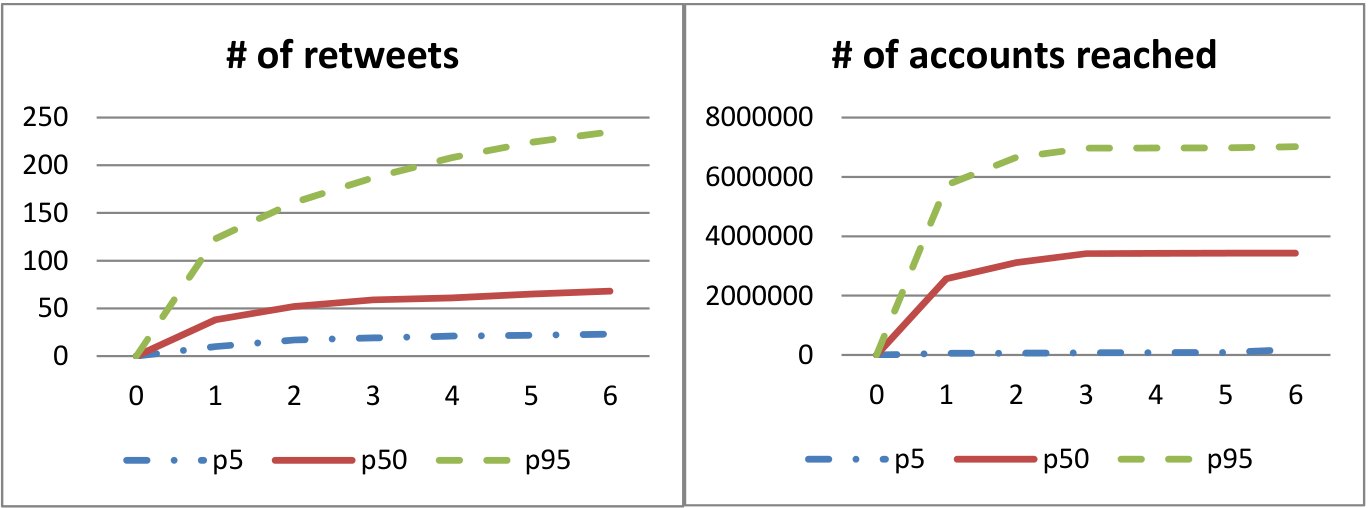
- Small numbers, large reach. A news tweet averages 68 retweets in its first hour, yet those retweets can reach more than 3 million accounts.
- Retweet speed predicts trading speed. For fast-spreading tweets, 25.0% of first-hour trading happens in the first ten minutes; for slow ones, 13.4%.
- Retail investors react most. Matched with 35,443 brokerage accounts, the link is strongest for investors holding more than $100,000 in stocks, and account holders are net buyers after a tweet.
- Price pressure, then reversal. A one standard deviation increase in a tweet's reach goes with a 23 basis point higher return through the close and a narrower bid-ask spread. The gain is completely reversed the next day.
- The spread is predictable from the first ten minutes. Quick early retweets by well-followed users, pictures and hashtags predict faster spread; links slow it. Predicted reach reproduces the same rise and reversal, which argues against reverse causality.
Contributions
- A direct, news-specific measure of information diffusion over time: the share of retweets, or of followers reached, minute by minute after a tweet.
- Evidence linking that diffusion to intraday trading, through both a market-wide measure of retail volume and account-level brokerage records.
- The classic pattern of attention-driven buying and later reversal, compressed into a single day.
- Cascade-prediction methods from computer science brought into finance, with predicted diffusion used to address reverse causality, including an out-of-sample test.
Figures
Related work
Cite
@techreport{chawla2017information,
  title       = {Information Diffusion on Social Media: Does It Affect Trading, Return, and Liquidity?},
  author      = {Chawla, Nitesh and Da, Zhi and Xu, Jian and Ye, Mao},
  year        = {2017},
  type        = {Working Paper},
  number      = {2935138},
  institution = {SSRN},
  doi         = {10.2139/ssrn.2935138},
  url         = {https://ssrn.com/abstract=2935138}
}